
Navigating Navigation Part 4: Riding a new route safely
- 12 minutes ago
- 4 min read
What happens when the plan meets reality.
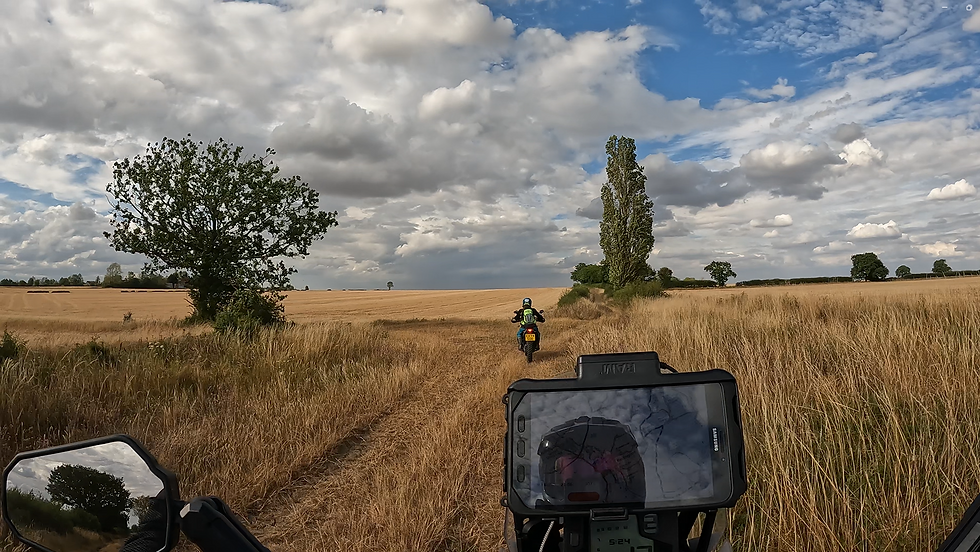
Riding a new route for the first time can be exciting, but it’s also challenging and requires a lot of concentration, so be prepared to take it slowly. It’s better to stop and check the route frequently than to get in a pickle with directions or keep having to turn around on narrow lanes. Make sure you always ride in company so you’ve got at least one buddy to help out if anything goes awry – and to share the new discoveries with!
If you’re not used to navigating with the mapping app you’ll be using, it’s worth practicing on familiar routes first so that you can concentrate on following the route and reading the terrain, rather than working out what you’re looking at on the map or how the app functions work.
Tips for map reading
· Familiarise yourself with the map and route before you set off. Scan the route from start to finish to remind yourself of potential tricky areas, the general orientation of the route and anywhere you’ve planned to stop.
· Stop at the beginning of each section of green lane to check the map for what’s coming up – when you’re riding off-road on unfamiliar or rough terrain, your eyes need to be on the trail ahead, not trying to work out the map.
· Also check road sections on the map before you ride them. Where there are lots of turnings coming up, make a mental note of their sequence, especially if you’re riding through towns or villages with many junctions close together.
· Unlike a turn-by-turn satnav, mapping apps don’t automatically zoom in or out for junctions, although some may respond to speed. You may need to manually zoom in or out on your map at different times so that you can see a larger area when you’re travelling at higher speeds on the roads, more detail in villages, or to see exactly where the entrance to a trail is.
· Mapping apps will let you either fix your map to North (North Up or Free Map), like a traditional map, or to have the map rotate with you (Heading Up or Compass Mode) so it’s always showing the direction you’re pointing in. North Up is good for giving an overview of the route and helps you learn the layout of an area. Heading Up matches the map to your physical reality so you don’t have to mentally calculate the direction of turnings. Both settings have advantages and disadvantages that suit different people and situations, so it may be necessary to experiment and see which suits you and when.

· Noting features or landmarks on the map helps you identify what’s coming up – for example, you can see that your route will turn off at the edge of a section of woodland, or the entrance to the trail is just after a line of electricity pylons or between two buildings.
· Look for visual clues in the landscape. There may be areas where the route of the green road isn’t immediately obvious, for example, across a grass field, but you if you look ahead, you can spot the gateway it will exit the field through, or the road winding over the brow of the hill.
· Check for signage – many byways have finger or arrow signs to mark the route which helps you make sure you’re on the byway rather than inadvertently riding along a footpath or farm track.
What it’s like navigating on the ground
On the ground, things can look very different to the map. It’s one thing knowing there's a ford ahead, but the reality may be that it's not safely passable on the day. Make sure someone else knows your intended route, and that you have a fully charged mobile phone. Be aware that some areas may not have network coverage, so consider a device like a Personal Locator Beacon or satellite messenger and keep it on your person, not on the bike.
By its nature, when you’re riding somewhere unfamiliar, even with the best preparation, the unexpected will happen. There may be corners you can’t see around, junction layouts that weren’t clear from the map, areas that are busy with cyclists or tedious amounts of gates. Water crossings and puddles can have hidden obstacles – and hidden depths. Some sections may take a lot longer to ride than you anticipated, and fallen trees, flooded lanes or closed roads may force you to find a different way around. Be prepared to adjust your plans.

You’ll be constantly reading the terrain ahead for bumps, ruts, loose surfaces, mud, tree branches, walkers, animals and every other type of trail hazard, without the benefit of knowing what’s coming up. So take it slowly and be aware of when you’re starting to get tired. It’s better to cut the route short than soldier on when you're too tired to concentrate.
If you come across a closed road or blocked trail or need to cut your route short, you may also need to be able navigate directly from the map rather than follow your pre-planned route. This map-to-ground navigation is another skill that takes practice, so try and find opportunities in daily life where you can try it out – perhaps on foot or bicycle. Being confident in navigation helps you keep calm and make better decisions if you’re faced with unexpected situations.
Explore with confidence
Planning a new route takes time, thought and skills. Many prefer to follow a route someone else has planned, but although challenging, exploring the route you’ve planned can be intensely satisfying and full of discoveries about the landscape, terrain and area. It can also be a real test of your skills, finding the way while keeping your concentration on riding the bike, judging the terrain and choosing a line.

Many riders love the thrill of setting off to explore somewhere new. While others may have ridden those roads before, every new route is your own adventure, with its own challenges, discoveries and memorable moments.
If all this sounds fascinating, you'll probably enjoy planning your own routes. If it sounds like rather a lot of homework... we'd be delighted to do it for you. Take a look at our ride dates.


Comments